Saturday, April 9, 2011

The Wisdom of Kass

The Leon Kass reading on cloning that we studied in class was part of a longer article that is available in its entirety here.

Many critics take issue with Kass's claim that there is a wisdom to repugnance.  Here is a typical objection to Kass's view:
"Anyone who as ever taken an introductory anthropology course, or read Herodotus -- or gone to a different part of town -- will have learned that different groups feel disgust at different things. The affect seems to be hard-wired into us, but the occasions provoking it are varied.
...
"In short, disgust is not quite so unambiguous and inarguable an expression of timeless values as [Kass] has advertised. Given a choice between 'deep wisdom' and 'reason’s power fully to articulate,' we might do best to leave the ineffable to Oprah."
Moral psychologist Jonathan Haidt argues that one big difference between politically conservative and liberal people is the willingness to consider disgust as a morally relevant factor.  Here's his TED talk on this:

What do you think?  Feel free to let us know in the comments of this post.

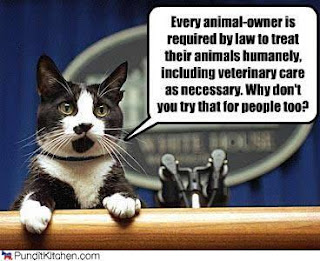
LolCats Have Deep, Ineffable Wisdom

Thursday, April 7, 2011

Clone Wars

Here are some links on cloning:
Multiplicity

Wednesday, April 6, 2011

Health Care Readings

In case you weren't there, here are links to the two articles I handed out in class tonight as assigned reading for next week's discussion about the economics of health care:
  1. U.S. Health Care Reform
  2. G.O.P. Blueprint Would Remake Health Policy
PolitiCat Gets Political

Tuesday, April 5, 2011

The Ethics of Killing

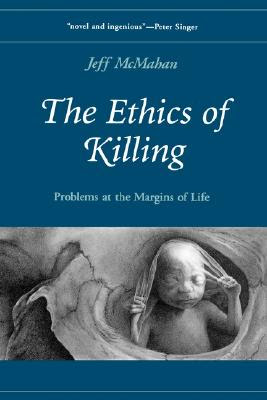
Creepy CoverIf you're interested in some thoughtful analysis of abortion, euthanasia, stem cells, impaired infants, cloning, killing, and personhood, among other things, you should check out Jeff McMahan's The Ethics of Killing. Here's a short description of the book:
"This magisterial work is the first comprehensive study of the ethics of killing, where the moral status of the individual killed is uncertain. Drawing on philosophical notions of personal identity and the immorality of killing, McMahan looks carefully at a host of practical issues, including abortion, infanticide, the killing of animals, assisted suicide, and euthanasia."
McMahan teaches philosophy at Rutgers. He also just wrote a follow-up book called Killing in War (here's an audio interview with him on that book). This is exactly the kind of careful, thought-out approach that I think difficult, important issues deserve.

Sunday, April 3, 2011

Owning Our Ignorance

Owning Our Microphones
I advise the Owning Our Ignorance club here at CCC.  We have a lot of nerdy discussions, host movie nights, and do other stuff in pursuit of getting better at learning.  If you join our Facebook group, you'll be automatically invited to all our events. 

Our big project this semester is creating a radio show.  Well, the first episode of the Owning Our Ignorance Show airs this Tuesday at 9:00 a.m. on WDBK, the college radio station.  Tune in to 91.5 FM to hear Calvin, Destiny, Jordan, and Rachel discuss the role that humility plays in effective reasoning.

If you like the show, you can subscribe to the podcast here (or via iTunes).  Upcoming show topics include the following:
  • the most important questions
  • good vs. bad skepticism
  • persuasion
  • happiness
  • art
  • prejudice
  • Ayn Rand
  • our top 5 to learn lists 
  • cognitive biases
Cats Always Hit the Post

Saturday, April 2, 2011

Sandel's Justice

Michael Sandel wrote one of the articles we're reading on stem-cell research. He's also a political philosophy professor at Harvard. You can watch videos of his course on Justice here. The last episode is related to some of the stuff we're studying in class (abortion and same-sex marriage), so I've put up the video of it below:


Friday, April 1, 2011

Delusions of Gender

Let's End the Great Gender Lie
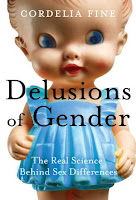
Psychologist Cordelia Fine has a great new book out called Delusions of Gender. In it, she debunks a lot of the myths about so-called 'hard-wired' gender differences between boys and girls. Our brains are much more malleable than these myths suggest, and such perceived gender differences are likely either non-existent or the result of social pressures.

Fine wrote a nice summary of her book here, and there are two good reviews of her book here and here.  Below is an excerpt from a talk Fine recently gave.


Cordelia Fine: Discovering Sexism in Neuroscience
 
And speaking of social pressures to conform to your gender role, here's a comparison of the different words used in ads for boys’ toys and ads for girls’ toys.

Snails and Puppy Dog Tails?

Sugar and Spice?

Thursday, March 31, 2011

The Hard Sell, the Stem Cell

Here are some links on the ethics of stem-cell research:
What is the Moral Status of Seeds?

Monday, March 28, 2011

System Justification

NYU psychologist John Jost does a lot of work on something he calls system justification theory. This is our tendency to unconsciously rationalize the status quo, especially unjust social institutions. Scarily, his research suggests that those of us oppressed by such institutions have a stronger tendency to justify their existence.

Jost has a new book on this stuff. Here's a video dialogue about his research:

Saturday, March 26, 2011

Your Inner Bigot

There's an insightful article called "Finding Your Inner Bigot" that relates to our discussion in class this week on racism and sexism: does prejudice have to be conscious, or can we unintentionally do something sexist or racist?

Psychological evidence suggests that unconscious prejudice is real, and often a bigger problem today than intentionally discriminatory behavior. As the article puts it,
"If you ask physicians whether all patients should be treated equally regardless of race, everyone says yes. But if you ask doctors how they will treat patients with chest pains who are named Michael Smith and Tyrone Smith, the doctors tend to be less aggressive in treating the patient with the black-sounding name. Such disparities in treatment are not predicted by the conscious attitudes that doctors profess, but by their unconscious attitudes—their hidden brains."
Counteracting these unintentional, hidden prejudices is pretty tough. They require a long-term approach of the kind discussed in Aristotle's virtue ethics: noticing your bad habits, then consciously trying to break them and replace them with better habits. The hardest part about unconscious biases, though, is how difficult they are to notice in the first place.
We Think We Know, But We Have No Idea